
Sheet Metal Bending
Reliable bend accuracy, clean edges, and repeatable assemblies. KaiSpeed combines fast quoting, engineer-led DFM, and downstream laser cutting, hardware insertion, welding, finishing, and assembly for true one-stop delivery.
All uploads are secure and confidential
What is Sheet Metal Bending?
Press-brake forming plastically deforms sheet stock along a straight axis to create flanges, channels, and enclosures. Common methods include air bending, bottoming, and coining—air bending is widely used for flexibility and speed; bottoming reduces springback and improves angle consistency; coining achieves very high precision at higher force/cost.
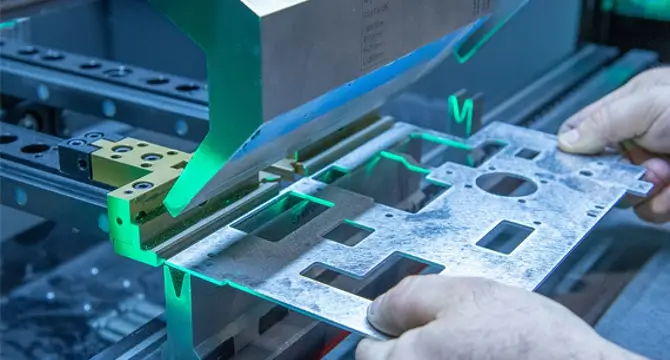
Bending Methods We Support
-
Air Bending
Most flexible; one toolset covers many angles; fastest for prototypes/varied SKUs.
-
Bottoming
Sheet contacts the die; less springback and tighter angles; excellent for repeatability.
-
Forming Ops
Hems, joggles/offsets, Z-bends, U-channels, ribs/beads, roll-forming (project-based).
Why Choose KaiSpeed
Consistent results: Stable angles and bend-to-bend dimensions for parts that assemble cleanly.
Engineer-led DFM: Early feedback on bend radii, flange length, hole-to-bend distance, reliefs, and grain direction to avoid rework.
End-to-end delivery: Cutting → bending → hardware (PEM®) → welding → finishing → assembly.
Quality & documentation: ISO-aligned process control, material certs, inspection reports, and FAI/PPAP on request.
Clear communication: Practical manufacturability notes, photos, and checkpoints from RFQ to shipment.
24/7 Support • Fast Global Delivery • Secure NDA Protection
How to Work With Us
01. Upload Your CAD
Choose your process (CNC, sheet metal, injection molding, 3D printing, etc.) and upload your files.
NDA-backed confidentiality
Secure transfer (STEP/IGES/ PDF)
02. Get Quote & DFM
Select material, finish, and quantity. Receive a clear quote plus DFM feedback to optimize cost, lead time, and quality.
Typical within 24 hours
Alternative process/ material options when helpful
03. We Start Production
Once approved, we begin manufacturing to your drawing and GD&T requirements.
In-process QC and FAI on request
Photo updates and milestone reports
04. Receive Your Parts
After final inspection, we pack and ship to your door.
Dimensional/CMM reports available
Global shipping (NA/EU often 3–10 days)
Materials & Surface Finish
Materials
We provide a wide range of materials, including metals, plastics, and composites.
Surface Finishes
We offer superior surface finishes that enhance part durability and aesthetics for applications requiring smooth or textured surfaces.
FAQs
Bending uses a press brake to plastically deform sheet along a straight line. A punch drives the sheet into a die to create V-, U-, and channel forms. Core variables are angle, inside radius, bend allowance/K-factor, tonnage, and springback. Common methods: air bending (most flexible), bottoming (less springback), and coining (highest precision at higher force).
It depends. Bending gives seamless corners, fewer parts, faster cycles, and lower cost (no fillers/heat tint). Welding is indispensable for frames, very large geometries, or shapes a press brake can’t form. Many designs use both: bend what’s efficient, weld only where needed.
Typical outcomes (with proper tooling and setup):
Angle tolerance: up to ±1°
Linear features (bend-to-bend/overall): ±0.1–0.2 mm
Results vary with alloy/temper, thickness, leg length, bend length, and fixture strategy. We’ll confirm from your drawing during DFM.
They can be—especially on soft alloys and cosmetic faces. Mitigation:
Protective film or peel-off laminate on visible faces
Urethane/soft dies, larger die radii, or reduced clamping pressure where feasible
Grain direction planning for brushed finishes
Post-process deburr, brush, bead-blast, polish, paint, or powder coat
Yes—limited by press-brake tonnage, V-die opening, bend length, alloy, and radius. As a practical guide, we commonly bend 0.5–6.0 mm; thicker gauges (to ~10–12 mm) are case-by-case and depend on bend length and material strength. Share your material, thickness, and flange length and we’ll validate tonnage/tooling.
Among common sheet metals, stainless steels (304/316) and high-strength steels resist bending and exhibit more springback; titanium can be even more challenging. Use larger inside radii, appropriate V-die openings, and allow for springback in the program.
A good starting point:
Inside radius: ≈ 1× material thickness (t) for mild steel/5052; increase for 6061-T6 and stainless
Minimum flange length: ≥ 4× t (air bending)
Hole-to-bend clearance: ≥ 1.5× t + inside radius
K-factor: start at 0.30–0.45, then tune per alloy/thickness/tooling
CNC press brakes with precision backgauges, tool libraries, and in-process angle measurement; FAI for new parts on request; check fixtures/go/no-go gauges; and final inspection per drawing. Material certs and reports are available.