
When designing lightweight, high-performance components, the choice between magnesium vs aluminum casting can significantly impact your product’s weight, strength, cost, and longevity.
Both metals are widely used in automotive, aerospace, electronics, and industrial applications. But which one is right for your next CNC machined part?
At KaiSpeed, we help engineers and procurement professionals navigate exactly these material decisions. This guide compares magnesium vs aluminum casting across density, strength, corrosion resistance, machinability, and cost — so you can make an informed choice.
[Explore our CNC machining capabilities] – see how we machine both materials.
Quick Comparison: Magnesium vs Aluminum Casting at a Glance
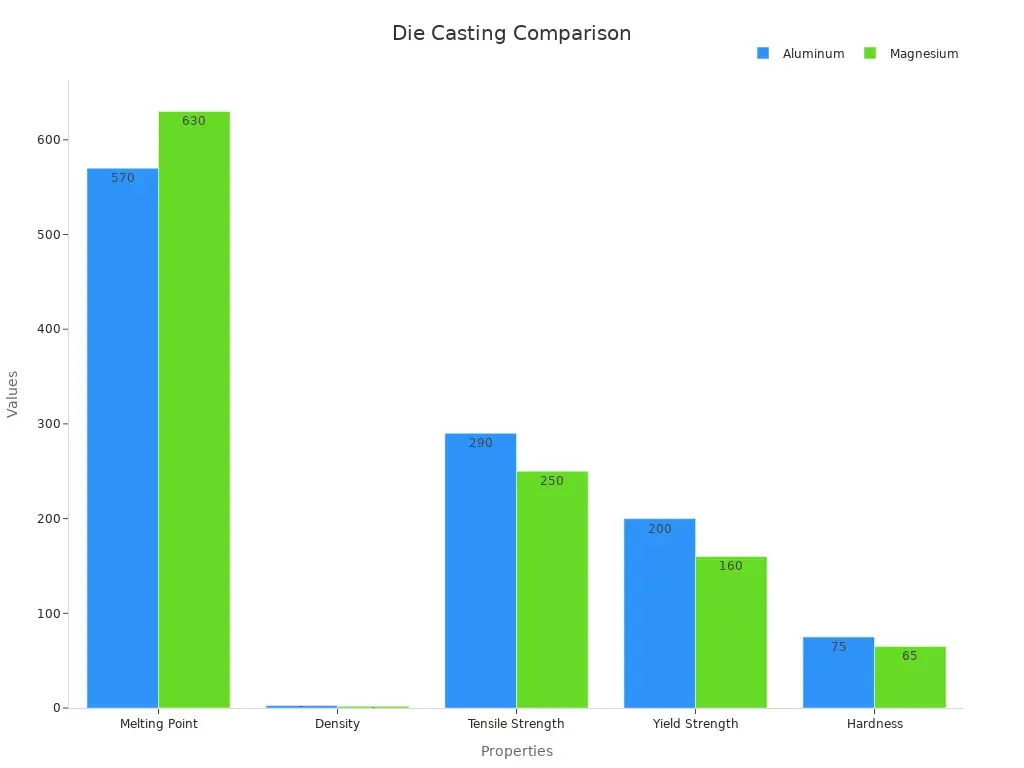
| Property | Magnesium | Aluminum |
|---|---|---|
| Density | 1.74 g/cm³ (lighter) | 2.70 g/cm³ (~35% heavier) |
| Tensile Strength | 130–300 MPa | 70–750 MPa (alloy dependent) |
| Yield Strength | 65–160 MPa | Often >270 MPa |
| Stiffness (Elastic Modulus) | Lower (~45 GPa) | Higher (~70 GPa) |
| Melting Point | ~650°C | ~660°C (similar) |
| Thermal Conductivity | ~156 W/m·K | ~237 W/m·K (better) |
| Corrosion Resistance | Poor (needs coating) | Good (natural oxide layer) |
| Machinability | Excellent (fast cutting) | Good |
| Die Casting Cycle Time | Faster | Slower |
| Raw Material Cost | Higher | Lower |
| Best For | Extreme weight reduction | Balanced strength, cost, corrosion |
See more material options in our material selection guide.
What is Magnesium Casting?
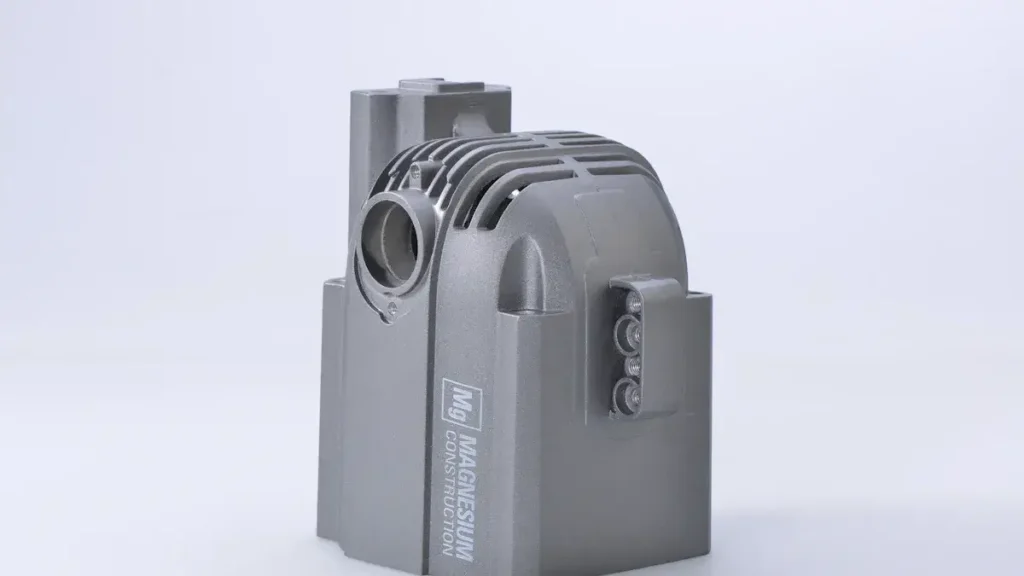
Magnesium casting is a manufacturing process where molten magnesium alloy is injected into a die cavity to form complex, near-net-shape parts. It is typically done using hot chamber die casting machines (similar to zinc) because magnesium has a relatively low melting point.
Common magnesium casting alloys:
- AZ91D – 9% aluminum, 1% zinc; good corrosion resistance and castability
- AM50A / AM60B – Higher ductility and impact resistance
- AS41B – Better creep resistance for high-temperature applications
Typical applications for magnesium castings:
- Automotive: steering wheels, seat frames, instrument panels, transfer cases
- Aerospace: non-critical interior components, gearbox housings
- Electronics: laptop frames, camera bodies, drone arms
- Industrial: handheld tools, robotics components
What is Aluminum Casting?
Aluminum casting is a widely used process where molten aluminum alloy is poured or injected into a mold. It can be done via die casting, sand casting, or permanent mold casting. Aluminum is the most common non-ferrous casting metal due to its excellent balance of properties.
Common aluminum casting alloys:
- A380 – Most common die casting alloy; good strength and corrosion resistance
- A356 / A357 – Heat-treatable; excellent mechanical properties for structural parts
- ADC12 – Similar to A380; widely used in Asia
Typical applications for aluminum castings:
- Automotive: engine blocks, transmission housings, wheels, suspension components
- Aerospace: fuselage frames, wing ribs, landing gear parts
- Consumer goods: cookware, furniture, power tool housings
- Industrial: pump housings, heat sinks, electrical enclosures
[custom aluminum casting and machining] – learn about our aluminum capabilities.
Pros and Cons of Magnesium Casting
Advantages of Magnesium Casting
| Advantage | Why It Matters |
|---|---|
| Extremely lightweight | 35% lighter than aluminum – ideal for weight-sensitive applications |
| High strength-to-weight ratio | Excellent for aerospace and automotive where every gram counts |
| Faster casting cycles | Lower melting point and faster solidification reduce cycle time |
| Thin-wall capability | Can cast walls as thin as 0.8–1.2 mm (better than aluminum) |
| Excellent machinability | Faster cutting speeds, lower tool wear compared to aluminum |
| Good vibration damping | Reduces noise and vibration in housings and supports |
| High thermal conductivity | Effective for heat dissipation in electronics |
Disadvantages of Magnesium Casting
| Disadvantage | Why It Matters |
|---|---|
| Poor corrosion resistance | Requires protective coatings (anodizing, E-coat, powder coat) |
| Higher raw material cost | Magnesium is more expensive than aluminum |
| Reactive / flammable | Fine chips and dust pose fire risk; requires specialized machining safety |
| Lower absolute strength | Not as strong as many aluminum alloys in load-bearing applications |
| Lower stiffness | Deflects more under load; may need thicker sections |
| Limited alloy availability | Fewer commercial alloys compared to aluminum |
| Complex recycling | Less established recycling infrastructure than aluminum |
Pros and Cons of Aluminum Casting
Advantages of Aluminum Casting
| Advantage | Why It Matters |
|---|---|
| Excellent corrosion resistance | Natural oxide layer protects in most environments |
| Good strength-to-weight ratio | Lighter than steel, stronger than magnesium |
| Wide alloy selection | Hundreds of alloys for specific needs (strength, ductility, heat treat) |
| Good machinability | Well-understood, widely available CNC processes |
| High thermal conductivity | Excellent for heat sinks and thermal management parts |
| High electrical conductivity | Suitable for electrical enclosures and busbars |
| Highly recyclable | Well-established, energy-efficient recycling |
| Lower material cost | More abundant and affordable than magnesium |
| Better stiffness | 1.5x stiffer than magnesium for the same geometry |
Disadvantages of Aluminum Casting
| Disadvantage | Why It Matters |
|---|---|
| Heavier than magnesium | ~35% denser; not ideal for extreme weight reduction |
| Slower casting cycles | Higher melting point and slower solidification |
| Lower damping capacity | More vibration transmission than magnesium |
| Shorter tool life in die casting | More abrasive to dies compared to magnesium |
| Susceptible to porosity | Can absorb hydrogen gas during melting |
Head-to-Head Comparison: Magnesium vs Aluminum Casting
Density and Weight
| Metal | Density (g/cm³) | Relative Weight |
|---|---|---|
| Magnesium | 1.74 | Baseline (lightest structural metal) |
| Aluminum | 2.70 | ~35% heavier |
Winner: Magnesium – For applications where every gram matters.
Strength and Stiffness
| Property | Magnesium | Aluminum |
|---|---|---|
| Tensile Strength (MPa) | 130–300 | 70–750 |
| Yield Strength (MPa) | 65–160 | Often >270 |
| Elastic Modulus (GPa) | ~45 | ~70 |
Winner: Aluminum – Higher absolute strength and stiffness.
Note: Magnesium wins on strength-to-weight ratio for some alloys, but aluminum wins on absolute strength for most structural applications.
Corrosion Resistance
| Metal | Natural Corrosion Resistance | Coating Needed? |
|---|---|---|
| Magnesium | Poor – reactive in moist/salt environments | Yes – anodizing, E-coat, or paint |
| Aluminum | Good – natural protective oxide layer | Optional for most environments |
Winner: Aluminum – Especially for outdoor, marine, or humid applications.
Machinability (CNC Perspective)
| Factor | Magnesium | Aluminum |
|---|---|---|
| Cutting speed | Faster | Moderate |
| Tool wear | Lower | Moderate |
| Surface finish | Excellent | Good |
| Safety concerns | Fire risk (fine chips/dust) | Minimal |
| Shop acceptance | Specialized shops only | Widely accepted |
Winner: Tie – Magnesium machines faster but requires safety controls. Aluminum is easier to source.
Important: Not every CNC shop will quote magnesium due to fire risk management. Always confirm your supplier is qualified.
Die Casting Cycle Time
| Metal | Relative Cycle Time | Reason |
|---|---|---|
| Magnesium | Faster | Lower melting point, faster solidification |
| Aluminum | Slower | Higher melting point, slower solidification |
Winner: Magnesium – Can reduce production cycle time in high-volume die casting.
Cost Comparison
| Cost Factor | Magnesium | Aluminum |
|---|---|---|
| Raw material cost | Higher ($/kg) | Lower ($/kg) |
| Die casting cost | Lower (faster cycles) | Higher (slower cycles) |
| Machining cost | Lower (faster cutting) | Moderate |
| Coating cost | Higher (required) | Lower (optional) |
| Total part cost | Higher for low volume; competitive for high volume | Generally lower |
Winner: Aluminum for most applications, but magnesium can be competitive at high volumes.
Magnesium vs Aluminum: Application Decision Guide
Choose Magnesium Casting When:
- Weight reduction is the #1 priority (aerospace, portable devices, racing components)
- Vibration damping is important (electronic housings, instrument panels)
- Thin walls are required (0.8–1.2 mm complex castings)
- High-volume die casting (cycle time savings add up)
- Components are protected from moisture (indoor or coated applications)
- Strength requirements are moderate (non-structural or low-load parts)
Typical magnesium parts: Seat frames, steering wheels, laptop housings, drone arms, camera bodies, transfer cases.
Choose Aluminum Casting When:
- Corrosion resistance is required (outdoor, marine, automotive under-hood)
- Higher strength and stiffness are needed (structural brackets, engine parts)
- Cost is a primary constraint (aluminum is cheaper)
- Part will be machined by standard CNC shops (wider acceptance)
- Thermal or electrical conductivity is important (heat sinks, electrical enclosures)
- Recyclability and sustainability are priorities
- Lower production volumes (less need for fast cycle times)
Typical aluminum parts: Engine blocks, transmission housings, wheels, pump housings, heat sinks, structural brackets.
Cost Comparison Table: Magnesium vs Aluminum Casting
| Cost Element | Magnesium | Aluminum | Notes |
|---|---|---|---|
| Raw material price (USD/kg) | ~$3.00–4.50 | ~$2.00–3.00 | Magnesium is 30-50% more expensive |
| Die casting tooling cost | Similar | Similar | Both require hardened steel dies |
| Cycle time | Faster (20-30% savings) | Baseline | Magnesium solidifies faster |
| Post-casting machining | Lower cost | Moderate | Magnesium cuts faster |
| Surface finishing | Higher (required) | Lower (optional) | Coating adds 10-20% to magnesium part cost |
| Scrap / recycling | Less established | Well-established | Aluminum scrap has better value |
| Total cost per part (high volume) | Competitive | Baseline | Magnesium can be cost-neutral at >50k units |
Machining Magnesium vs Aluminum: What CNC Shops Need to Know
If you are planning to CNC machine cast magnesium or aluminum parts, here are key differences:
| Machining Factor | Magnesium | Aluminum |
|---|---|---|
| Cutting speed | 500-1500 SFM | 300-800 SFM |
| Tool material | Carbide or HSS | Carbide |
| Coolant | Dry or minimal (fire risk with water-based) | Flood coolant preferred |
| Chip control | Critical – fine chips are flammable | Standard chip management |
| Fire safety | Class D fire extinguisher, clean work area | Standard precautions |
| Surface finish achievable | Ra 0.8–1.6 µm | Ra 1.6–3.2 µm |
| Dimensional stability | Excellent | Good |
Warning: Magnesium machining requires dedicated safety protocols. Always confirm your CNC partner is qualified.
FAQ
Q1: Is magnesium stronger than aluminum?
A: In absolute terms, no. Most aluminum alloys have higher tensile and yield strength than magnesium alloys. However, magnesium has a better strength-to-weight ratio for some alloys, meaning it can carry similar loads at lower weight.
Q2: Which is cheaper: magnesium or aluminum casting?
A: Aluminum is generally cheaper. Raw magnesium costs 30-50% more than aluminum, and magnesium parts almost always require protective coatings. However, at very high volumes (>50,000 units), faster die casting cycles can narrow the gap.
Q3: Does magnesium rust or corrode?
A: Yes, magnesium is highly reactive and corrodes faster than aluminum, especially in moist or salt environments. Protective coatings (anodizing, E-coat, powder coat, paint) are required for most magnesium applications.
Q4: Can magnesium be CNC machined?
A: Yes, magnesium machines excellently – faster than aluminum with less tool wear. However, fine magnesium chips and dust are flammable. Only qualified CNC shops with proper fire safety equipment should machine magnesium.
Q5: Which is better for automotive parts: magnesium or aluminum?
A: It depends on the part:
- Magnesium – interior parts, steering wheels, seat frames, instrument panels (weight reduction priority)
- Aluminum – engine blocks, wheels, suspension, chassis, transmission housings (strength, corrosion, cost priority)
Most automotive manufacturers use both where each excels.
Q6: Is magnesium casting suitable for outdoor applications?
A: Only with protective coatings. Untreated magnesium will corrode quickly outdoors. With proper anodizing, E-coat, or powder coating, magnesium can be used outdoors, but aluminum is still the more common choice.
Q7: Which material has better thermal conductivity?
A: Aluminum – ~237 W/m·K vs magnesium at ~156 W/m·K. Aluminum is the better choice for heat sinks and thermal management components.
Q8: Can you weld magnesium and aluminum castings?
A: Yes, but welding magnesium is more challenging than aluminum due to its reactivity and tendency to crack. Aluminum welding is well-understood and widely available.
Summary & Decision Matrix
Use this matrix to quickly decide between magnesium vs aluminum casting for your next CNC machined part:
| If your priority is… | Choose… |
|---|---|
| Lightest possible weight | Magnesium |
| Highest strength | Aluminum |
| Best corrosion resistance | Aluminum |
| Lowest cost | Aluminum |
| Fastest die casting cycles | Magnesium |
| Best machinability (speed) | Magnesium (with safety controls) |
| Easiest supply chain | Aluminum |
| Vibration damping | Magnesium |
| Thermal conductivity | Aluminum |
| Outdoor / marine use | Aluminum |
| High-volume production (>50k units) | Either (evaluate total cost) |
| Low-volume / prototyping | Aluminum (easier sourcing) |
Why KaiSpeed for Your Magnesium or Aluminum Casting + CNC Machining?
At KaiSpeed, we don’t just machine parts – we help you choose the right material for your application.
What we offer:
- CNC machining of both cast magnesium and aluminum parts
- Material selection guidance based on your performance, cost, and environment requirements
- Post-machining finishing including anodizing, coating, and plating
- Quality inspection with CMM and surface finish measurement
- Single-source accountability from casting to finished part
One supplier. One quality standard. One shipment.
[Request a quote for your project] – Upload your CAD file and let us recommend the best material.
Final Verdict: Magnesium vs Aluminum Casting
Choose Magnesium Casting when: Weight reduction is critical, parts will be protected from corrosion, and you have a qualified supply chain for casting and machining.
Choose Aluminum Casting when: You need balanced strength, corrosion resistance, cost-effectiveness, and easier sourcing – which covers the majority of applications.
For most B2B engineering projects, aluminum remains the default choice due to its excellent all-around properties, lower cost, and well-established manufacturing infrastructure. But when every gram counts, magnesium offers unparalleled weight savings.
Need help deciding? Email our engineering team your part drawing, and we’ll provide a material recommendation and quote within 48 hours.
KaiSpeed: Precision CNC machining. Engineered material solutions.