
The global electric vehicle (EV) market continues to accelerate. According to S&P Global Mobility, EV penetration of U.S. passenger car sales could reach 40% by 2030. For engineers, procurement managers, and manufacturing leaders in Europe and North America, this growth brings urgent challenges:
- How to achieve ±0.005 mm precision on complex battery components?
- How to manage thermal runaway with machined cooling channels?
- How to reduce weight without compromising structural integrity?
Traditional stamping and casting alone cannot meet these demands. Custom machining EV parts using multi-axis CNC technology has emerged as the critical enabler for next-generation electric vehicles.
At KaiSpeed, we specialize in high-precision custom machining for the EV sector. This engineering guide explains:
- Why custom machining is non-negotiable for EV components
- Top 7 parts that require CNC machining
- Thermal management and lightweighting techniques
- A real case study (prototype to production)
- 10 FAQs for buyers
- Selection criteria for machining partners
Explore our CNC machining capabilities designed specifically for EV applications.
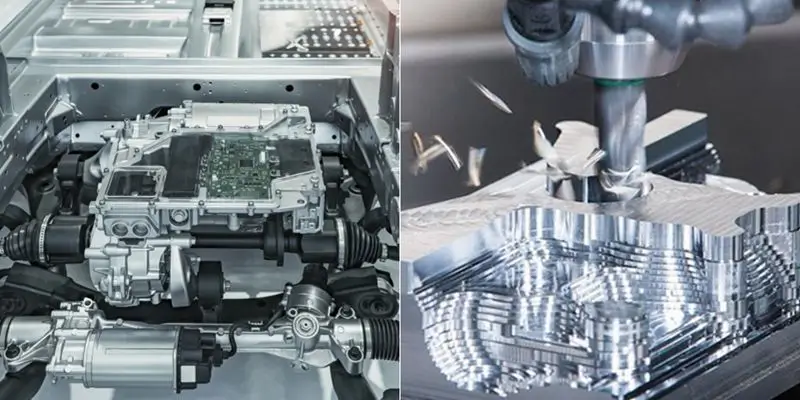
Why Custom Machining EV Parts is Critical in 2026
Unlike internal combustion engines (ICE), EVs operate on different principles: high-voltage electricity, instant torque, and large battery packs that generate significant heat. These create four specific manufacturing challenges that custom machining EV parts directly addresses.
1. Precision at Scale
EVs require tolerances that traditional automotive processes cannot consistently hold. For example:
- Busbar connectors: ±0.01 mm to prevent arcing
- Rotor shafts: Concentricity ≤ 0.008 mm for smooth operation
- Cooling channels: ±0.03 mm to ensure uniform coolant flow
CNC machining achieves ±0.005 mm on critical features, with CMM verification on every batch.
Battery performance and safety depend on effective heat dissipation. Machining allows engineers to integrate complex cooling channels directly into aluminum plates and housings — something impossible with stamping.
2. Thermal Management
Industry data on thermal uniformity: Machined cooling plates with micro-channels (1.2 mm width) achieve up to 40% better temperature distribution compared to stamped alternatives.
3. Lightweight Engineering
Every 10 kg saved extends EV range by approximately 5-7 km. Custom CNC machining enables topology optimization — removing material where stress is low while maintaining strength where needed.
Common lightweighting techniques:
- Pocket milling on structural brackets (30-40% weight reduction)
- Ribbing and webbing on large covers
- Switching from steel to aluminum 7075 or magnesium alloys
4. Material Versatility
EV components require diverse materials for different functions:
- Aluminum 6061/6063: Thermal management and housings
- Aluminum 7075: High-strength suspension brackets
- Copper C110: High-current busbars
- Engineering plastics (PEEK, ABS): Insulating components
Custom machining handles all of these in one shop — without retooling.
Top 7 EV Components That Demand Custom Machining
Below is a technical breakdown of EV components where CNC machining is preferred or required, based on industry practice and KaiSpeed’s project experience.
| Component | Typical Materials | Why Custom Machining? | Standard Tolerance |
|---|---|---|---|
| Battery cooling plates | 6061-T6 Al | Serpentine channels for coolant; leak-proof surface | ±0.03 mm |
| Motor housing / stator housing | Aluminum alloy | High concentricity for rotor alignment; vibration damping | ±0.01 mm |
| Busbar connectors | Copper C110 | Burr-free edges for high-voltage safety; exact hole spacing | ±0.01 mm |
| High-voltage enclosures | Aluminum, steel | Sealing grooves for IP67/IP69K waterproofing | ±0.05 mm |
| Lightweight suspension brackets | 7075-T6 Al | Topology-optimized pockets; weight reduction | ±0.05 mm |
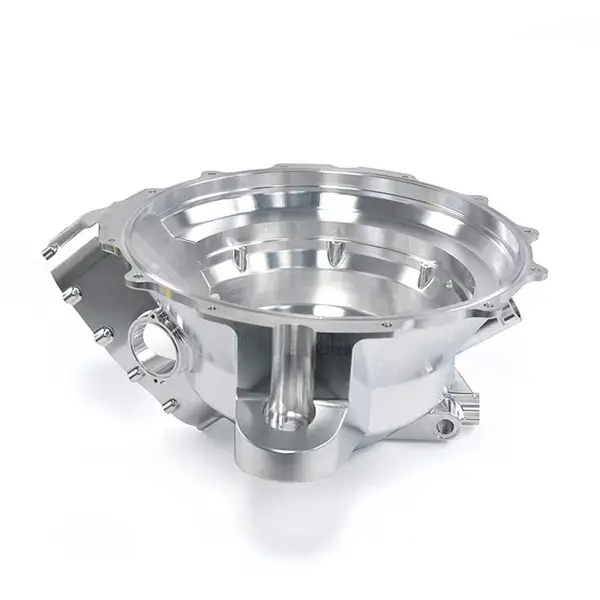
| Gearbox casing (EV transmission) | Aluminum | Integrated oil channels and bearing seats | ≤0.008 mm cylindricity |
| Exterior lighting housings | Engineering plastic, Al | Optical surface quality; watertight seals | ±0.05 mm |
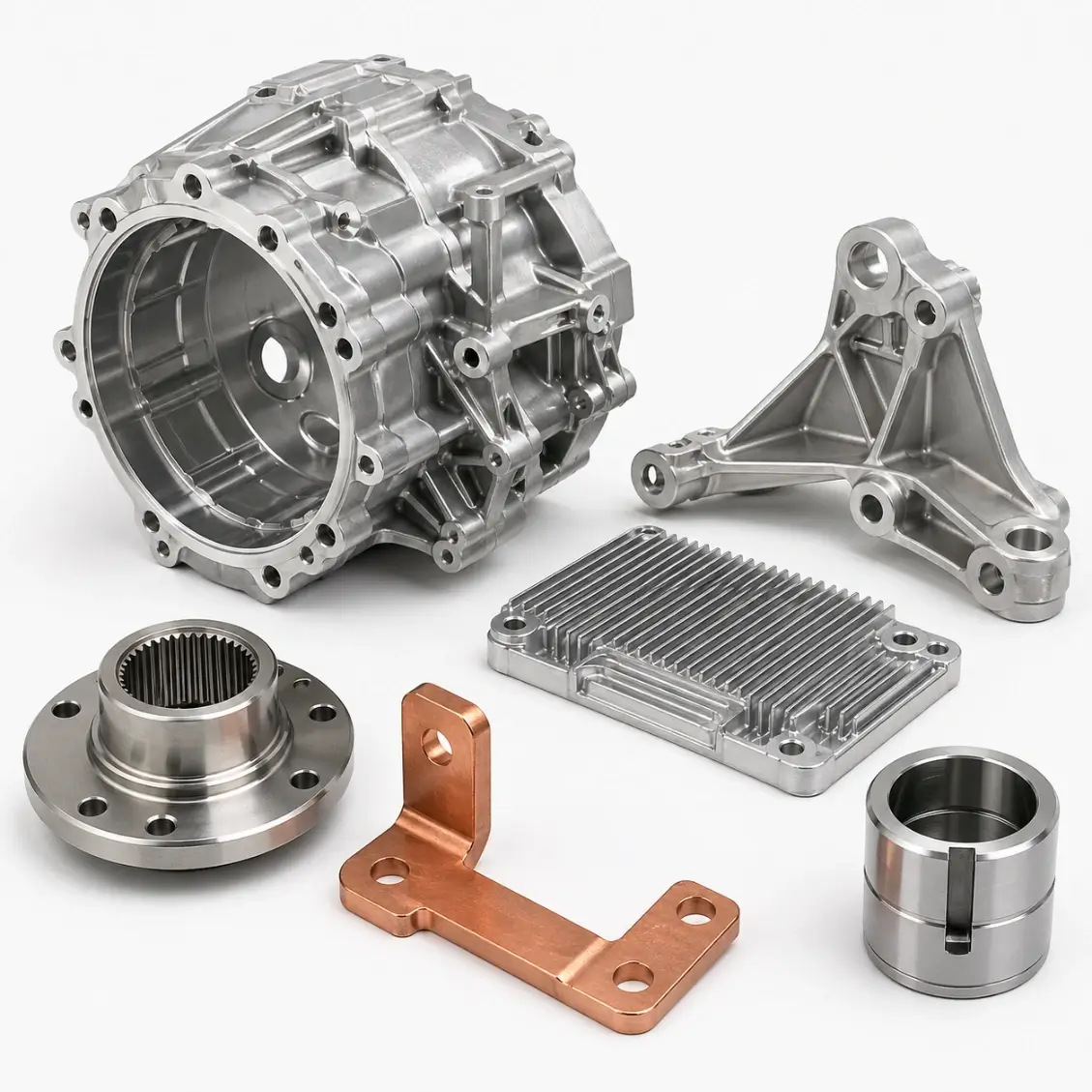
Deep Dive: Thermal Management & Lightweighting
Machining for Thermal Control
Thermal runaway remains the top safety concern for EV batteries. Custom machining allows engineers to integrate cooling channels directly into the battery housing or cooling plates — a design impossible with simple stamping.
KaiSpeed’s approach to thermal parts:
- High-speed milling of serpentine channels with consistent wall thickness (as narrow as 1.0 mm)
- Surface finishing optimized for heat transfer (Ra ≤ 0.8 µm)
- 100% leak testing (helium or vacuum) for every cooling plate
Result: Uniform cooling across the entire battery pack, reducing hot spots and extending cell life.
Lightweighting Through CNC Machining
Every 10% reduction in vehicle weight increases range by approximately 5-7%. Custom CNC machining enables three lightweighting strategies:
| Strategy | Description | Typical Weight Saving |
|---|---|---|
| Pocket milling | Removing material from non-stressed areas | 20-30% |
| Webbing/ribbing | Adding strength with minimal material | 15-25% |
| Material substitution | 7075 Al or Mg instead of steel | 40-60% |
KaiSpeed example: A suspension bracket originally designed as a steel weldment was redesigned as a single-piece machined 7075 aluminum component. Weight reduced by 52%, while stiffness improved by 18%.
Case Study: Custom Machining for an EV Battery Cooling Assembly
This case study reflects a typical project at KaiSpeed, inspired by industry best practices (including companies like GD Prototyping).
Background
A North American EV powertrain startup needed a complete thermal management assembly for their prototype battery pack:
- Components: Aluminum cooling plates (2 pcs) + battery housing frame + copper busbars (8 pcs)
- Quantity: 50 complete sets for beta testing
- Timeline: 3 weeks from design freeze to delivery
Technical Requirements
| Component | Critical Requirements |
|---|---|
| Cooling plates | Serpentine channels: 1.2 mm width ±0.03 mm; Surface flatness ≤0.1 mm; Zero leakage at 10 psi |
| Battery housing frame | IP67 sealing groove; Threaded holes with ±0.01 mm positional tolerance |
| Copper busbars | Burr-free edges; Tin plating for corrosion resistance; ±0.01 mm hole spacing |
KaiSpeed Solution
Our team implemented a multi-stage CNC machining strategy:
| Component | Process | Key Parameters |
|---|---|---|
| Cooling plates | 5-axis high-speed milling | 12,000 rpm; 15 m/min feed; vacuum fixture to prevent distortion |
| Housing frame | 4-axis CNC + custom fixture | Sequential rough-finish strategy; in-process probing for flatness |
| Busbars | Precision turning + milling | High-pressure coolant; deburring station; third-party plating |
Quality assurance:
- CMM inspection for all critical dimensions (reports provided)
- Helium leak testing for cooling plates (zero leakage at 10 psi)
- Microscope inspection for burrs on busbars
Results
| Metric | Target | Achieved |
|---|---|---|
| Delivery time | 21 days | 18 days |
| Cooling channel tolerance | ±0.03 mm | ±0.02 mm |
| Leak test pass rate | 100% | 100% |
| First-pass yield | >95% | 98.5% |
Outcome: The customer successfully integrated the assembly into their beta battery pack and placed a follow-up production order for 500 units within 60 days.
Need a similar solution? Start with our rapid prototyping for EVs.
FAQ About Custom Machining EV Parts
This FAQ is based on real questions from KaiSpeed’s engineering and procurement clients.
Q1: What EV parts can be made with custom machining?
A: Almost any precision component, including: battery housings, cooling plates, motor shafts, stator housings, busbars, lightweight brackets, gearbox casings, charging connectors, exterior lighting housings, and interior structural parts.
Q2: Which materials are best for custom machining EV parts?
A:
- Aluminum (6061, 6063, 7075): Most common for lightweight strength and thermal conductivity.
- Copper (C110): Essential for high-current busbars (requires burr-free machining).
- Stainless steel (303, 304, 316): For durability in exposed connectors.
- Engineering plastics (PEEK, Acetal, Nylon, ABS): For insulation or lightweight non-structural parts.
- Titanium: For high-strength, low-weight fasteners in performance EVs.
Q3: How precise can custom machining EV parts be?
A: With multi-axis CNC (3, 4, or 5-axis), we achieve:
- Linear tolerances: ±0.005 mm (micron-level)
- Concentricity: ≤ 0.008 mm
- Surface finish: Ra 0.4 – 1.6 µm (as machined)
- Flatness on large parts (e.g., battery trays): ≤ 0.1 mm
Q4: Do you support both EV prototyping and mass production?
A: Yes. KaiSpeed provides:
- Rapid prototyping: 5–15 days for most EV components
- Scalable production: 10 units to 50,000+ units per year — same CNC programs, no retooling
Q5: Can CNC machining support thermal management components?
A: Absolutely. We specialize in:
- Heat sinks with complex fin geometries
- Cooling plates with micro-channels (width from 1.0 mm)
- Thermal housings with integrated fluid ports
Vacuum or helium leak testing is standard for all fluid-carrying parts.
Q6: How do you control deformation when machining thin-walled EV parts?
A: We use four strategies:
- Symmetrical machining sequences to balance residual stresses
- Optimized cutting parameters (light radial engagement, high feed)
- Stress-relief heat treatment before final finishing
- In-process probing to measure and compensate for spring-back
Result: Deformation consistently below 0.1 mm even on walls as thin as 1.2 mm.
Q7: What quality certifications does KaiSpeed hold?
A: We are ISO 9001:2015 certified and comply with automotive-grade quality requirements. We provide:
- First Article Inspection (FAI) reports
- CMM measurement data
- Material certifications
- PPAP level 3 documentation (upon request)
External reference: ISO 9001:2015 standards for quality management systems.
Q8: How does 5-axis machining compare to 3-axis for EV parts?
A: Here is a technical comparison:
| Feature | 3-Axis Machining | 5-Axis Machining |
|---|---|---|
| Setups required | 3–6 | 1 |
| Cumulative error | High (±0.1 mm+) | Very low (±0.005 mm) |
| Complex geometry (cooling channels, undercuts) | Limited | Unlimited |
| Cycle time | Long | 30–50% shorter |
| Surface finish on complex surfaces | Good | Excellent |
| Best for | Simple brackets, flat plates | Battery trays, motor housings, cooling plates |
Q9: What surface finishes are available for machined EV parts?
A: Full range:
- As machined: Ra 1.6 µm (standard)
- Anodizing (clear, black, colors): Corrosion protection + electrical insulation
- Powder coating: Heavy-duty enclosures
- Polishing: Cosmetic exterior parts
- Bead blasting: Uniform matte finish
- Plating (tin, silver, nickel): Busbars and connectors
Q10: How can I get a quote for my EV component?
A: Simple process:
- Upload your 3D CAD file (STEP, IGES, STP, or STL) to our request-a-quote page
- Specify material, quantity, and special requirements (tolerances, finish, etc.)
- Receive DFM feedback within 24 hours and a firm quote within 48 hours
The KaiSpeed Advantage: Choosing a Custom Machining Partner
For B2B buyers (engineers, VPs, procurement), selecting a custom machining partner for EV parts is a strategic decision. Here’s what differentiates KaiSpeed:
True Multi-Axis Capability (3, 4, and 5-Axis)
We don’t just own multi-axis machines — our engineers know how to program them for optimal tool paths, collision avoidance, and in-process verification. This is essential for complex EV parts like cooling plates, motor housings, and battery enclosures.
Rapid Prototyping DNA
Unlike high-volume-only shops, we are built for speed. Typical lead times:
- Prototypes: 5–15 days
- Production (100–10,000 units): 15–25 days
In-House Quality Lab
| Equipment | Purpose |
|---|---|
| CMM (Zeiss) | Geometric tolerances, flatness, concentricity |
| Surface roughness tester | Ra, Rz measurements |
| Helium leak tester | Cooling plates, enclosures, fluid parts |
| Hardness tester | Aluminum, steel, copper |
Every critical dimension is inspected and reported.
Material Expertise for EV
We stock and machine all EV-relevant alloys in-house:
- Aluminum: 6061, 6063, 7075, 2024, 5052
- Copper: C110, C182
- Stainless: 303, 304, 316, 17-4 PH
- Plastics: PEEK, Acetal, Nylon 6/6, ABS, Polycarbonate
Scalability Without Retooling
Start with 10 prototype units. When you’re ready for 10,000 units, we don’t need new molds or tools. The same CNC programs scale seamlessly.
Transparent Communication
- Real-time production tracking (photos + status updates)
- DFM feedback before machining
- Full documentation with every shipment
Industry Trends: The Future of Custom Machining for EVs
Based on industry analysis and KaiSpeed’s roadmap, the future of custom machining EV parts will focus on:
- Integrated thermal-structural parts – Combining cooling channels into structural housings (e.g., battery tray with integrated cooling) to reduce assembly steps and weight.
- Sustainable material sourcing – Increased use of recycled aluminum and bio-based engineering plastics.
- Automated in-process inspection – Real-time probing and tool wear monitoring for zero-defect production.
- 5-axis for large-format EV castings – Finish-machining of cast aluminum battery trays to correct distortion while maintaining lightweighting.
- Shorter lead times everywhere – KaiSpeed is investing in automation and 24/5 operations to offer standard 5-day delivery for many EV components.
Call to Action: Engineer Your EV Success with KaiSpeed
Whether you are designing a new battery enclosure, a lightweight motor mount, a complex cooling manifold, or a custom busbar, custom machining EV parts from KaiSpeed delivers the precision, thermal performance, and weight savings your project demands.
Why work with KaiSpeed?
- ✓ Multi-axis CNC (3, 4, 5-axis) with ±0.005 mm accuracy
- ✓ ISO 9001:2015 certified
- ✓ Fast turnaround: Prototypes in 5 days, production in 15 days
- ✓ Full traceability and inspection documentation
- ✓ Competitive pricing for European and North American buyers
- ✓ DFM support to optimize your design for machining
Ready to move your EV project forward?
👉 Get an instant quote or DFM review
👉 Email us directly: [email protected]
👉 Call us: +86 1587 5013 993
Let’s machine the future of mobility — together.