
The bridge between a brilliant concept and a market-ready product is paved with critical decisions.
For engineers, procurement managers, founders, and manufacturing VPs, perhaps the most strategic question is:
Should we choose injection molding vs CNC machining for prototyping?
This is no longer a simple “prototype vs production” debate.
It is a business decision affecting:
- Time-to-market
- Cash flow exposure
- Engineering agility
- Supply chain scalability
- Long-term unit economics
At KaiSpeed, we support global product teams from concept validation to full production. The real answer is rarely either/or — it’s about selecting the right process at the right stage.
Let’s break it down.
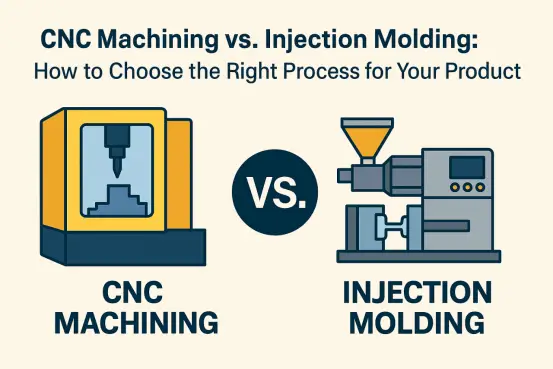
The Core Philosophy: Subtraction vs Replication
Understanding the fundamental difference clarifies everything.
CNC Machining: The Power of Subtraction
CNC machining removes material from a solid block to create your part.
No molds. No tooling investment. No long setup.
Through our CNC Machining Services, engineers upload a CAD file and receive precision parts in days.
Why it matters:
- Instant iteration
- Tight tolerances
- Broadest material selection
- Zero tooling commitment
CNC is about control and flexibility.
Injection Molding: The Science of Replication
Injection molding creates a mold first — then replicates parts at scale.
Through our Injection Molding Services, we design aluminum or steel molds and produce highly repeatable plastic components.
Why it matters:
- Extremely low per-unit cost at volume
- High repeatability
- Surface consistency
- Ideal for consumer-ready parts
Injection molding is about scalability and efficiency.
Head-to-Head: Injection Molding vs CNC Machining
| Criteria | CNC Machining (KaiSpeed Expertise) | Injection Molding |
|---|---|---|
| First Part Lead Time | Days | Weeks |
| Upfront Cost | Low | High (tooling required) |
| Per-Part Cost | Stable at low volume | Drops dramatically at high volume |
| Tolerances | ±0.001″ achievable | ±0.003″–0.005″ typical |
| Design Changes | Immediate | Costly mold modification |
| Materials | Metals + Plastics + Engineering Polymers | Primarily thermoplastics |
| Ideal Volume | 1–1,000 units | 1,000+ units |
| Risk Level | Low financial risk | Higher upfront capital risk |
Cost Analysis: Where ROI Shifts
Cost is where the injection molding vs CNC machining debate becomes strategic.
CNC Machining Cost Structure
- No tooling cost
- Pay per part
- Ideal for small batches
- Predictable cost
Injection Molding Cost Structure
- Mold investment: $3,000–$50,000+
- Very low per-part cost after tooling
- Strong economies of scale
Example Breakpoint Logic
If you need:
- 50 units → CNC wins decisively
- 500 units → Case evaluation required
- 5,000 units → Injection molding dominates
At KaiSpeed, we provide side-by-side cost modeling so engineering and finance teams can see the crossover point clearly.
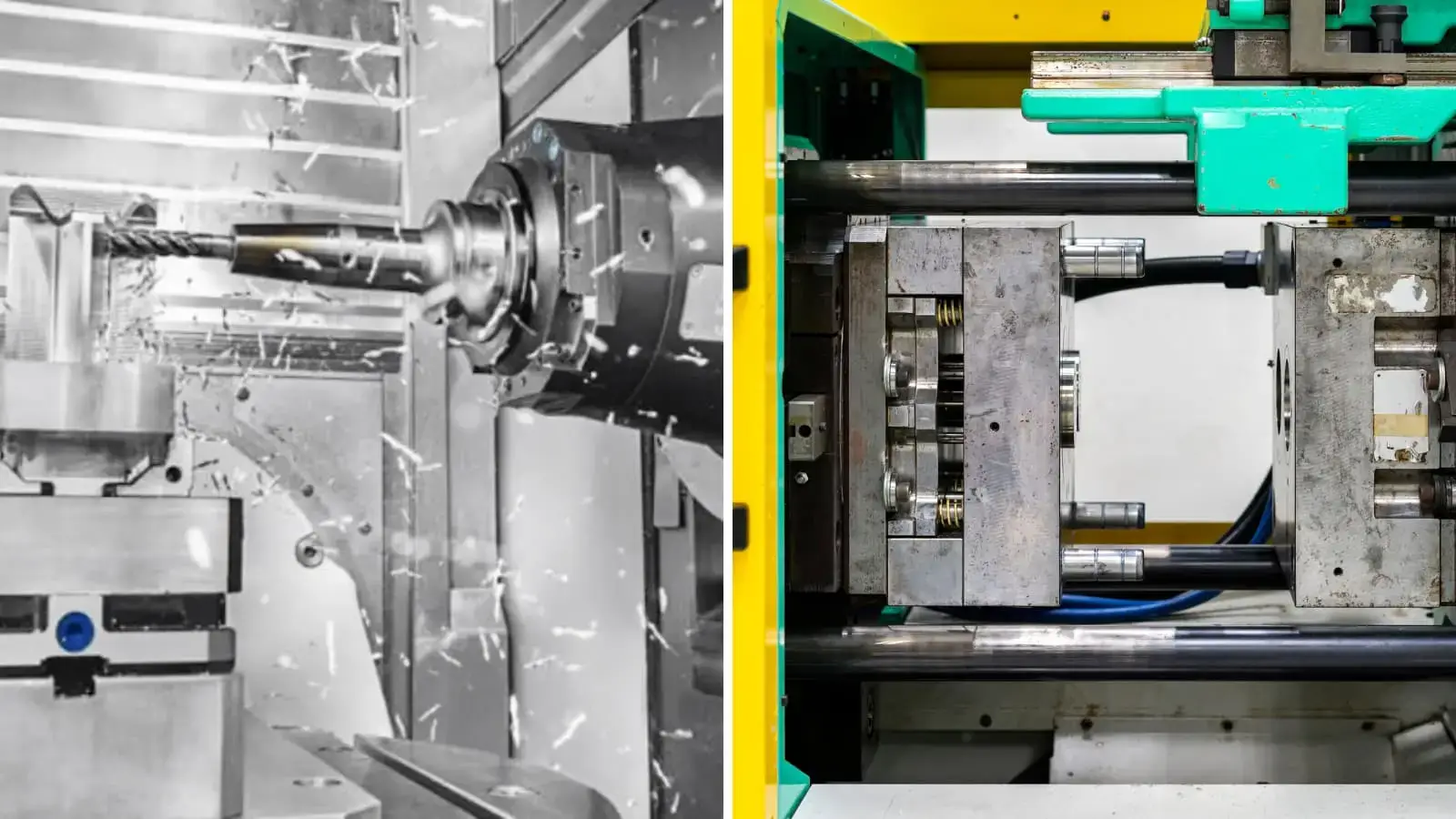
When to Choose CNC Machining for Prototyping
1. Your Design Is Still Evolving
Early-stage development requires iteration.
With CNC machining:
- Update CAD
- Regenerate toolpath
- Produce new part
No mold revision. No delay.
If your product is in testing phase, CNC reduces risk.
2. You Need Metal or High-Performance Materials
Injection molding is limited to plastics.
CNC supports:
- Aluminum 6061 / 7075
- Stainless steel 304 / 316
- Brass
- PEEK
- Delrin (POM)
- Engineering composites
If structural performance matters, CNC is the only choice.
3. Volume Is Below 1,000 Units
Tooling amortization kills ROI at low volumes.
CNC keeps your capital free for:
- Marketing
- Hiring
- Product refinement
4. Speed Is Critical
Investor demo tomorrow?
Trade show next week?
CNC machining delivers the fastest path from file to physical.
When Injection Molding Makes Strategic Sense
Injection molding becomes optimal when:
Volume Is Confirmed
10,000+ units annually?
Injection molding provides unbeatable unit economics.
Design Is Frozen
If engineering changes are unlikely, tooling risk decreases.
Geometry Demands It
Certain features perform better molded:
- Living hinges
- Complex snap fits
- Thin-wall plastic parts
- Overmolding
Hybrid Strategy: Smart Teams Use Both
Modern product development doesn’t choose sides.
It sequences processes.
Typical KaiSpeed roadmap:
- CNC prototypes for validation
- Functional testing & design refinement
- Rapid aluminum tooling for pilot run
- Steel production mold for scale
Our Rapid Prototyping Services are specifically designed to bridge prototype to production smoothly.
This hybrid approach:
- Minimizes financial exposure
- Reduces tooling rework
- Accelerates time-to-market
- Optimizes total lifecycle cost
Risk Assessment for B2B Decision Makers
| Risk Type | CNC Machining | Injection Molding |
|---|---|---|
| Financial Risk | Low | High upfront |
| Design Risk | Very Low | Moderate |
| Timeline Risk | Low | Medium |
| Scaling Risk | Moderate | Low |
For startups → CNC reduces risk.
For established OEMs → Injection molding accelerates margin growth.
Final Decision Framework
Ask your team:
- Is the design finalized?
- What is the expected 12-month volume?
- How many iterations remain?
- What is our capital budget?
- Is speed or per-unit cost more important right now?
There is no universal winner.
There is only the right stage-specific decision.
FAQ: Injection Molding vs CNC Machining
1. Is CNC machining always cheaper than injection molding?
For low volumes, yes. For high volumes, injection molding becomes significantly cheaper per unit once tooling cost is amortized.
2. How many parts justify switching to injection molding?
Typically between 1,000–5,000 units depending on part complexity and tooling cost.
3. Can CNC machining produce production-quality parts?
Yes. CNC can produce end-use parts with tight tolerances and high-strength materials. Many aerospace and industrial components are permanently CNC machined.
4. Does injection molding offer better surface finish?
Injection molding offers highly repeatable cosmetic surfaces. CNC can also achieve excellent finishes but may require secondary finishing for aesthetic consumer products.
5. What is the fastest method for prototyping?
CNC machining is generally the fastest because it requires no mold creation.
6. What is the cost difference between injection molding and CNC machining for prototypes?
For prototypes under 100 units, CNC machining is typically 3–10× more cost-effective because it requires no mold tooling. Injection molding involves an upfront tooling cost that can range from several thousand to tens of thousands of dollars. However, once volume exceeds several thousand parts, injection molding usually becomes more economical per unit.
7. Which is better for low-volume production: injection molding or CNC machining?
For low-volume production under 1,000 units, CNC machining is often the better choice due to zero tooling investment and faster design flexibility. Injection molding becomes competitive when volumes are stable and repeat orders are expected, especially when aluminum rapid tooling is used.
8. Can injection molding be used for rapid prototyping?
Yes, but it depends on the timeline and budget. Rapid injection molding using aluminum tooling can shorten lead times compared to hardened steel molds. However, it is still slower and more expensive upfront than CNC machining for early-stage prototypes.
9. How do tolerances compare in injection molding vs CNC machining?
CNC machining typically achieves tighter tolerances (around ±0.001″) compared to injection molding (typically ±0.003″ to ±0.005″). For precision assemblies or mechanical interfaces, CNC machining generally offers superior dimensional control.
10. Is CNC machining stronger than injection molding?
It depends on the material. CNC machining allows the use of metals such as aluminum and stainless steel, which provide significantly higher structural strength. Injection molding is limited to plastics and elastomers, though glass-filled materials can improve strength.
11. When should I transition from CNC prototypes to injection molding?
The transition usually makes sense when:
- The design is finalized
- Expected annual volume exceeds 1,000–5,000 units
- Unit cost reduction becomes a priority
- Cosmetic consistency is critical
A cost crossover analysis can determine the optimal timing.
12. Does injection molding provide better surface finish than CNC machining?
Injection molding can provide highly repeatable cosmetic surfaces directly from the mold. CNC machining also achieves excellent finishes, but aesthetic consumer-grade surfaces may require additional polishing or coating processes.
13. Which process is more scalable: injection molding or CNC machining?
Injection molding is significantly more scalable for high-volume production. Once the mold is built, thousands or millions of identical parts can be produced with consistent quality and low per-unit cost. CNC machining scales linearly with machine time and capacity.
14. What are the risks of choosing injection molding too early?
Choosing injection molding too early can result in:
- Expensive mold modifications
- Delayed timelines
- High upfront capital exposure
- Design lock-in before validation
For evolving designs, CNC machining typically reduces financial and engineering risk.
15. How does material selection affect the injection molding vs CNC machining decision?
If your final product requires metal components, high-temperature plastics like PEEK, or specialized composites, CNC machining may be necessary. If the final production material is a thermoplastic resin, injection molding provides the most accurate mass-production simulation.
Conclusion: Choose Strategy, Not Just Process
Choose CNC machining for:
- Speed
- Precision
- Design flexibility
- Low financial exposure
Choose injection molding for:
- Scale
- Cost efficiency at volume
- Production consistency
At KaiSpeed, we guide you through both.
🚀 Ready to Evaluate Your Project?
Upload your CAD files today for an instant quote, or contact our engineering team to discuss which strategy—injection molding vs CNC machining—is right for your project’s future.
Our engineering team will:
- Provide DFM feedback
- Compare CNC vs molding costs
- Recommend the optimal roadmap
- Deliver transparent pricing within 24 hours